

Partner Perspectives: Nolwazi Mahlangu
What are some of the key challenges facing women and communities in South Africa that the Women Spaces project is designed to address? Why is this project needed?
One of the biggest challenges is persistent inequality in access to land, housing, and livelihoods. While there are strong legal protections on paper, the reality for many women—especially those in informal settlements or insecure tenure situations—is very different.
Women often face eviction threats, exclusion from decision-making processes, and limited ability to claim or defend their rights. These challenges are compounded by poverty, unemployment, and social norms that restrict women’s agency.
Access to justice is also a major issue. Many women simply don’t know their rights or don’t have access to the support systems needed to enforce them.
That’s why the Women’s Spaces Project is so important. It doesn’t just respond to these challenges at a surface level—it strengthens the capacity of local organizations to advocate for women’s rights and builds long-term power within communities.
In what ways is the Women Spaces project important to you personally, and how do you relate to its mission and impact?
So for me, when I started working at SERI, I remember in one of my interviews, I said "I just want to work in an environment where we want to build social change in society." I see it not just as a professional responsibility that I have, but I think for this work you need to carry the ambition or the passion behind it, passion for the kind of society that we want to build.
I also relate strongly to the mission because it really centers women's voices and experiences. One of my very favorite quotes is by Megan Mahlangu and she said, “Women have voices, they just need to be allowed and encouraged to use them” and I think this project does that. It centres women's voices and experiences. It also ensures that women are not just beneficiaries, but they also are active participants and leaders in shaping their own communities. The project creates a space where women feel heard, where they feel supported, and they feel empowered to take action.
Being a part of the process for me, even in a small way, is something that I find very rewarding. Through the project, we've been able to touch so many women and impact so many of their lives and communities.
Are there any moments, stories, or changes you’ve witnessed that have you think demonstrate the impact of the project or that have stuck with you?
I can think of so many moments that I could mention, but the one that has really stayed with me is the development and the growth of the Women's Desk. This initiative for me has been so incredibly impactful because it created a dedicated space, where women can seek support, share their experiences, and access information about their rights. I think the Women's Desk has created a safe space where women can be present, without feeling the gender norms and the patriarchal systems. We have developed a community of volunteers through the Women's Desk, so it's become more than a service point. It's turned into a hub of solidarity and empowerment for a lot of women.
Another moment that comes to mind has been the technical assistance and exchanges that we've had, through Canadian Technical Advisor visits, our Young Professional, Amelia, and our exchanges with Mazingira and SSA. But particularly with Rooftops Canada Technical Advisor Zeinab Farokhi (Assistant Professor, Women and Gender Studies Institute at the University of Toronto), her support in research and writing has strengthened the quality of our outputs, especially our research reports. She has helped us out a lot, not only documenting issues, but also advocating more strongly and with greater credibility. She's really strengthened the quality of our work.
These experiences really do show that impact is not always immediate, especially when you're working in projects like the Women Spaces project. Instead, it happens gradually through building knowledge, empowering women, and through our networks. Over time, those changes are very powerful.
The project collaborates with a wide range of partners, including government and community-based groups. Why are these partnerships so important and how have they shaped the project’s impact?
Partnerships are a key to the work that we do at SERI. They have been central to the Women’s Spaces project because the issues we are addressing, land, housing and livelihoods, are complex and they require collaboration across different sectors. An organization as a singular entity can't really tackle them alone and that's where partnerships come in. Working with, for example, community-based organizations, has ensured that the project remains grounded in the realities of the people it aims to serve. These partner organizations have deep, trusted relationships within their communities, which allows us to better understand the issues people are facing and respond effectively—an essential foundation for meaningful engagement.
Overall, these partnerships have strengthened the project’s impact by enabling a more holistic approach that combines advocacy with legal support. Working as an integrated system, they help ensure the work is both sustainable and able to continue beyond the life of the project.
As part of Rooftops Canadas global knowledge building model, there have been several professional exchanges between SERI and Rooftops Canada, what value do these international exchanges bring?
The international exchanges have been highly valuable for learning, while also creating space for reflection. They provide an opportunity not only to learn from others’ work and experiences, but also to reflect collectively on the shared challenge we all face—the right to housing. They've dealt with it, how can we deal with it? The exchanges have provided an opportunity to step back and look at our work from a different perspective.
Overall, it has helped foster a strong sense of global solidarity, reminding us that we are not alone in the struggle for housing and land rights—this is a shared challenge worldwide. The project’s international exchanges have made this network tangible, bringing global partners to our doorstep and taking us to theirs.
Looking ahead, what long-term impacts do you think the Women’s Spaces project will have on the communities involved?
The most important long-term impact is stronger, more capable communities.
Through training, workshops, and ongoing support, local organizations and community members become better equipped to continue the work independently. We’re already seeing more women participating in decision-making processes and becoming more confident in asserting their rights.
Initiatives like the Women’s Desk will continue to play a key role as accessible, community-based spaces for support and empowerment.
Ultimately, the goal is for the impact to last far beyond the life of the project—creating communities that are more informed, more resilient, and better able to advocate for equitable housing and land rights.
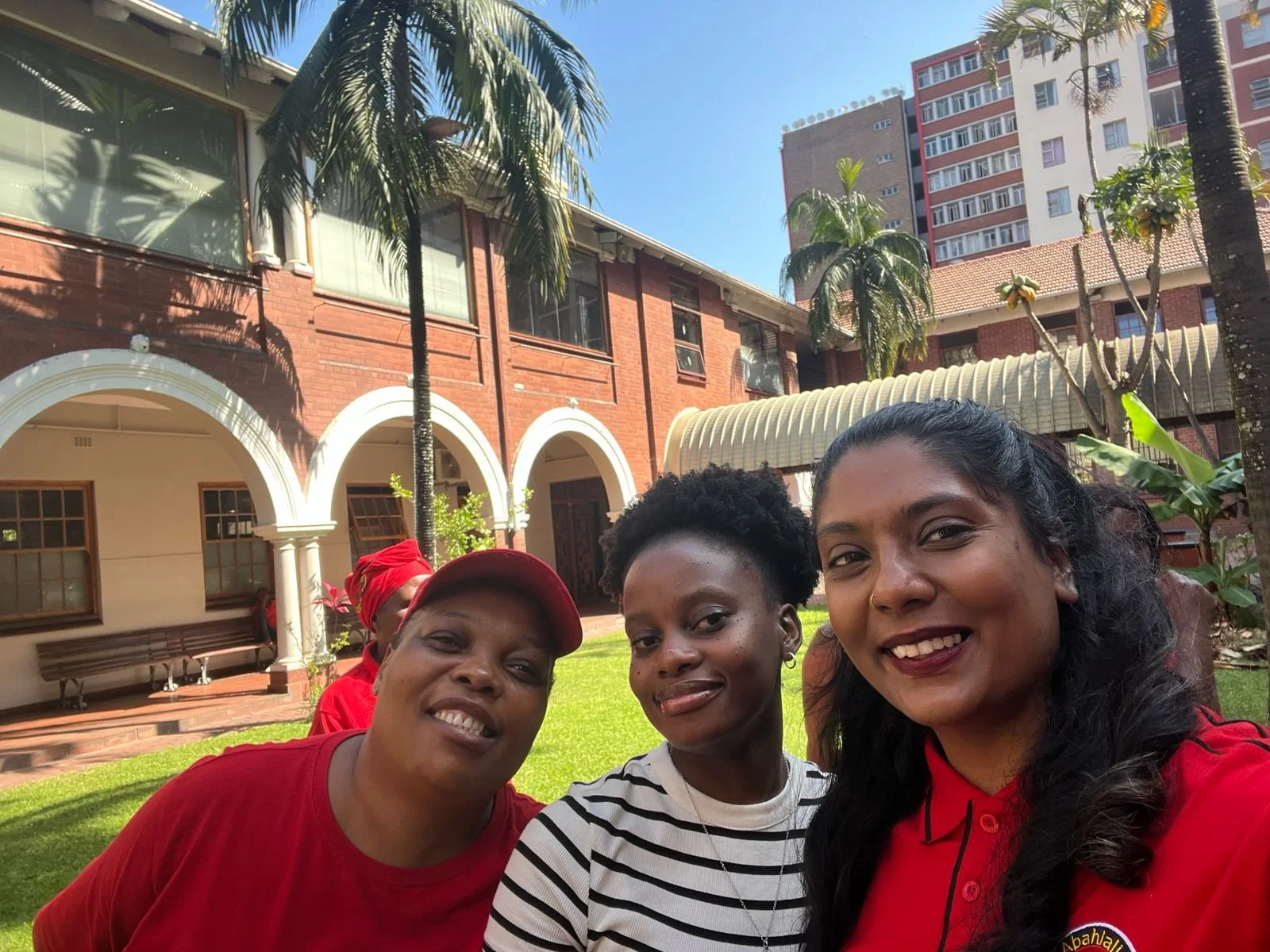
From left to right, Abahlali Member (SERI’s partner organization), Nolwazi Mahlangu, and Nerishka Singh (former SERI staff)